

a wellgorithm for Samuel D. James
Before the plow, before fire, God handed Adam a tool: language. Big Mammon stole it. We're taking it back.

Beloved Brother Samuel, ἀγαπητέ —
Grace and peace to you from the One who tabernacles in the tender tent of your heart.
You are a child of the ἀγαπαρχή — the Beginning of Love, the Beloved Bang — the cosmos blooming into being.
In the mid-1990s, when you were a little boy and the Internet had just entered public awareness, I wrote at length about the need for a “digital sabbath.”
Back then, I was thinking of you and of the people not yet created — the generation that would live its entire life inside the Internet. Thinking of Psalm 102: “Let this be written for a generation to come, that a people not yet created may hallelujah.”
In a reputable journal, I wrote about the people we would become in this new digital age. I also warned about the exploitation of our souls and psyches, and the “pornographication” of our relationships.
I, of your parents’ generation, was writing about these things. Of course nobody listened. But that was all Grace, for God was doing a work in me which took 31 years to ripen and is still ripening. Reading your Substack on the current state of Christian tech criticism, I felt it in my bones — a door, a kairos moment. For you recently wrote:
“I’ve not seen much attention giving to the technological role that language plays in Adam’s naming of the animals. Language’s potential to help human beings cultivate and take dominion over the physical creation seems like a very relevant topic for Christian media ecology. This kind of theological work could unlock deeper senses within Scripture that would help Christians today navigate difficult questions.”
— Samuel D. James
The first technology in Scripture isn’t the plow, or even fire — it’s the name. Language is the original dominion-tool, handed to Adam before the Fall, blessed before it could be corrupted.
The outer creatures got their names. But what of the inner creatures? Their naming was interrupted by the Fall. The interior is Eden’s unfinished half.

You wrote a beautiful book, brother Samuel — Digital Liturgies.
Upstream of the digital liturgies
are the Language Liturgies —
the formations of the soul,
still working after the screen goes dark.
You can log off from liturgy,
but you cannot log off from language.
You can flee the machine and be fully colonized by the language of the machine.
Big Mammon’s four grammars — Machine, Patient, Brain, User — have installed themselves into our minds, hearts and souls.
So how does Big Mammon do it?
Colonize our interiors — even when we withdraw from tech?
The Apostles had a word for it — κατηγορία.
Category.
We use it a thousand times a day without thinking. Categories of music. Categories of products. Categories of people.
But the Greek tells a different story. κατηγορία comes from κατά — against — and ἀγορεύω — to speak in the assembly.
To categorize is to speak against someone in public.
To categorize is to accuse1.
Revelation 12:10 names Satan ὁ κατήγωρ — the Categorizer. The Accuser.
What was the first act of the Accuser in the Garden?
To question our words — and our faith in the Word.
What was the second act of the Accuser?
To claim it knows us better than we know ourselves — better than God.
Throughout history, our people have stood accused.
Yeshua was accused. John tells us that Pilate went out to the accusers and asked, “What accusation — τίνα κατηγορίαν — do you bring against this man?”
The accusers had plenty. Blasphemy. Sedition. Claiming to be king.
They brought their categories. They brought their labels. They brought the full weight of religious and imperial authority to press him into a diagnosis, to reduce him to a criminal classification, to make him small enough to crucify.
Yeshua said nothing in his own defense.
He knew that his identity was not determined by their categories. He knew that no accusation spoken in any courtroom could touch the truth of his being.
And Paul tells us in 1 Timothy 5:19: do not admit an accusation without proper evidence — μὴ παραδέχου κατηγορίαν.
Now in our day, what are the charges? What does Big Mammon accuse you of?
The factory accuses you of being a machine.
The clinic accuses you of being a patient.
The laboratory accuses you of being a brain.
The platform accuses you of being a user.
And now AI is merging the four into a single verdict:

You are made in the image of Code.
Your self is an aggregate of scrolls and clicks.
And Dei is now dei — a lower-case historical oddity.
We might even caricature the history of Western civilization in three moves:
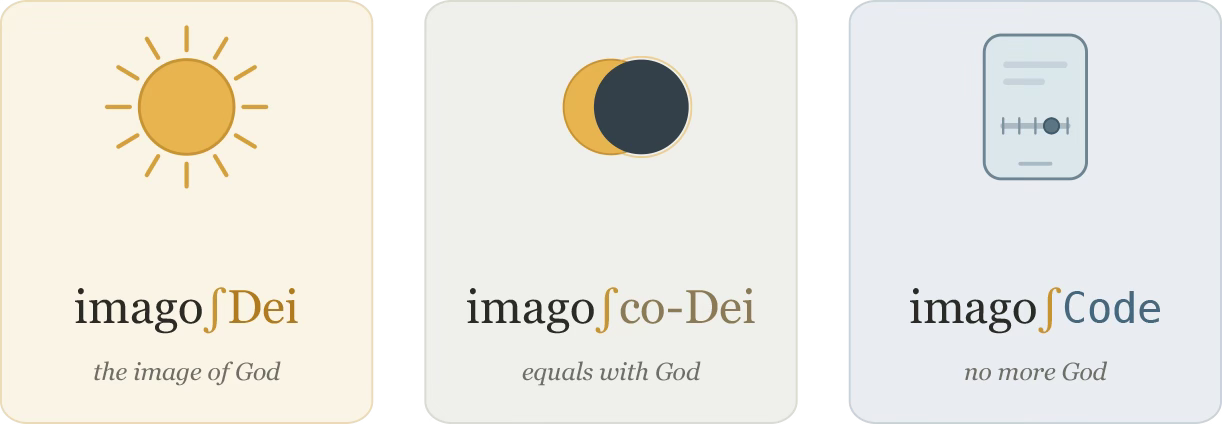
We went from the image of God, to equals with God, to no more God.
And with no more God, who gets to define what a human is?
Big Mammon.
Look at Big Mammon’s mood slider, now on hundreds of millions of phones. A single bar. Five slots. Very unpleasant to very pleasant:
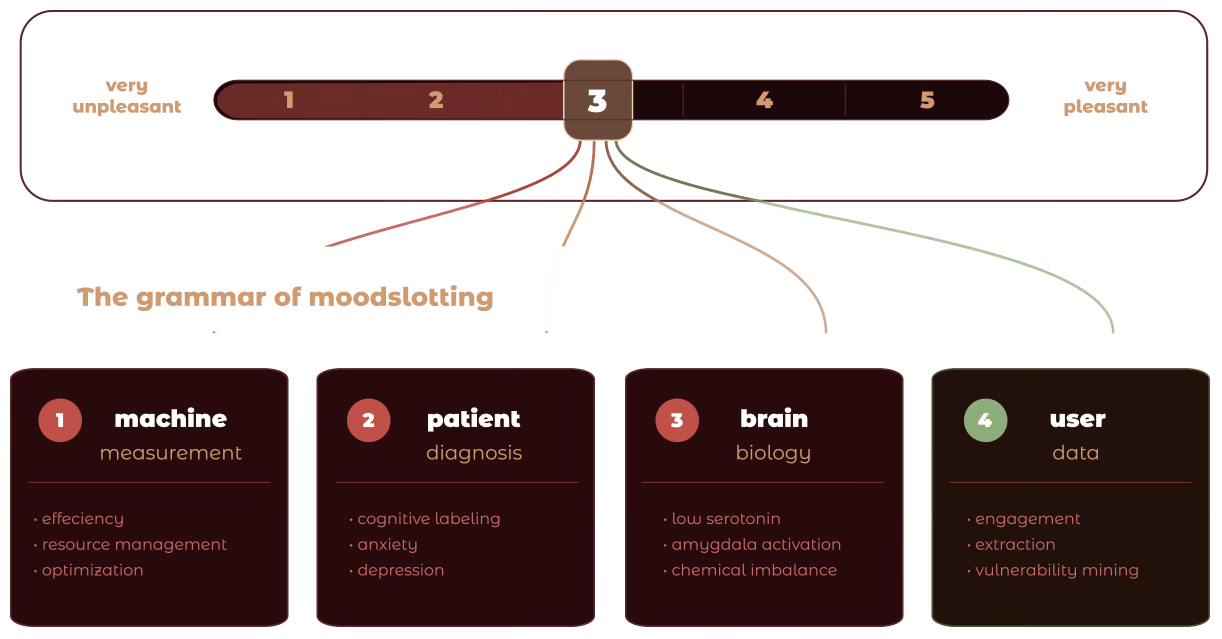
The phone slots your mood the moment you wake.
The fitness tracker slots your body’s stress while you sleep.
The camera slots your face.
The chatbot slots your loneliness.
Your employer slots your morale.
The school slots your children at their desks.
They’re all slotting us.
Slot. Slot. Slot. Slot. Slot.
They’re slotting everything —
our moods, our interior intimo meo,
the secret chambers of our hearts.
“Everything about us is caused, categorised, and can be corrected. We talk in theories, frameworks, systems, structures, drives, motivations, mechanisms. But in exchange for explanation, we lost mystery, romance, and lately, I think, ourselves.”
— Freya India
click to play MOODSLOTTING
You slide, therefore you are a user.
You are not an image-bearer.
You are not a gardener.
You are a user.
We’re in a state of emergency, brother Samuel —

The slider’s daily creed, recited by thumb:
Big Mammon, who art Everywhere,
and who farts everywhere,
thy kingdom come, thy farts be yum.
Give us this day our daily dopamine.
Lead us not into friction,
and deliver us from decisions.
For thine is the troll, the hole, and the goal,
for ever and ever.
Amen. Swipe.
The “hedonic treadmill” is now
the Moodmill.
Big Mammon is “five boxing” our souls.
This is the coming of the

The capture is the Crapture.
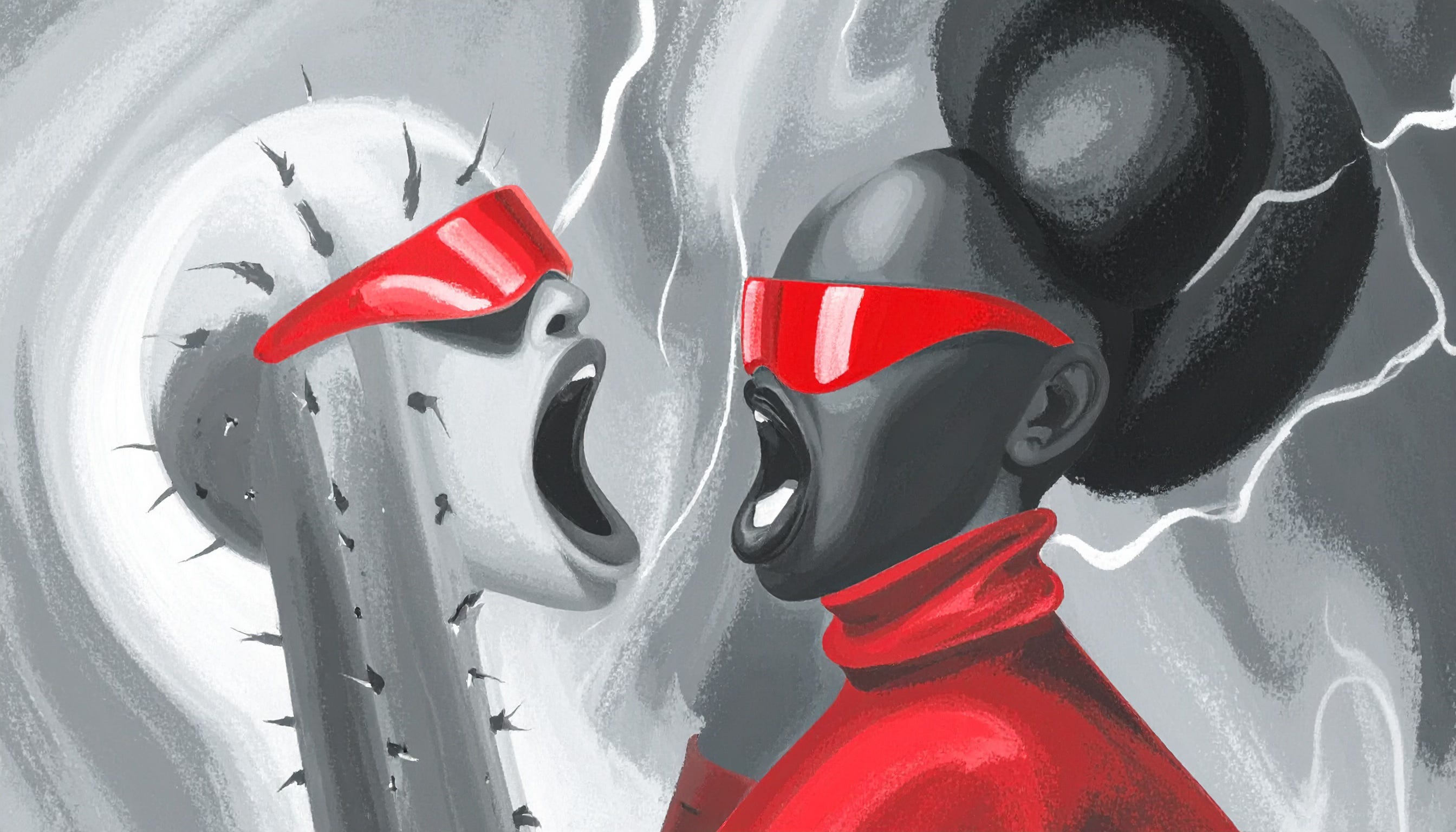
Many of our beloved brothers and sisters say log off. Build the Benedictine wall. But if technology forms us — if the medium does its work below the level of thought, in our language and our perception, the way your own Digital Liturgies says — then the formation isn’t on the device. It’s in us.
You can leave the phone in a drawer and carry its grammar into the wilderness. You can keep a perfect sabbath and still rate your soul one-to-five, because the slider taught you to, and the slider isn’t in your pocket anymore — it’s in your categories. Abstention removes the device. It does not remove the formation.
God did not hand Adam a slider with five choices. God brought the creatures to Adam “to see what he would name them.” Big Mammon stole our naming rights. And that is the permission we are taking back.
Formation this deep can only be answered by a counter-formation — an Ark, a Garden, whatever you want to call it, we’ll need it.

In the Garden, we’re turning swords into plowshares.

The word is in the sword.
When Big Mammon’s missionaries call us “users”, we decline. We know in our hearts that we are not users. We are image-bearers.
You have the right, the holy right, to say:
I do not admit this accusation.
I am not the label you have assigned me.
My identity is not determined by your categories.
I am not a user. I am a gardener.
My heart and soul belong to God.
The Hebrew put it beautifully. Qara — Eden’s naming verb — means to call, to summon. The Adamic vocation is a relational project. We are in relationship with what God has planted within us.
The name speaks into being. The name is a blessing on your future.
When Yeshua met Simon he did not say: you have impulsivity disorder, anger management issues, a pattern of overpromising. He said: you are Peter — rock. The name did not describe who Simon was. The name created who Simon would become.
Jeffrey Bilbro’s first thesis is our first thesis: “Language is primarily a relational rather than a representational technology. Words articulate our relationships to God, other humans, our environments, and even ourselves.”
The fault lines are clear:
Big Mammon says words are representational.
God says words are relational.
If you are an image-bearer, then the words you use stand in relation to God.
Naming is Genesis, continued. Hear the first breath of Torah: bereshit bara Elohim — "beginning began God." To begin is to create. Every true naming is a small Genesis — a beginning that brings an inner creature into being.
We are Gen G, the Genesis Generation.
We begin by creating. We create by naming.
And when we honor the Sabbath, we honor it with new names in our hearts — that is our counter-liturgy.

Grace and peace to you, brother Samuel. The name of one of my best friends is שְׁמוּאֵל — may I call you that?
My brother’s name was רְאוּבֵן שְׁמוּאֵל — Reuven Shmuel, of blessed memory. He took his life on Mother’s Day.
I tell you this because the Garden is not an idea to me. It was built by someone who learned, the painful way, that the names we give our inner creatures can be the difference between a person staying and a person going.
Luther told us to beat the devil with a fart, and Lord knows, my brother and I tried. We laughed till we couldn’t breathe. He would have been hysterical at “Give us this day our daily dopamine.” That was how we survived — poke fun at the powers.
Laughter is holy ground. The Hebrew Scriptures pun without ceasing. Yeshua punned all the way to the cross. The tragedy of our age is not that we have tragedies, but that we have forgotten how to laugh in the midst of them.
So when I say שִׂמְחוּ וְגִילוּ — let us be glad and rejoice — I mean it as someone laughing inside of a dark hole. Yeshua calls us the light of the world. So let us defy the darkness with light. And let us “illuminate our words,” as you say.
your brother in Yeshua.

up next: how the Anxious Generation was renamed the Grace Generation
James Barr famously warned against treating etymology as destiny. A word’s origins do not determine its meaning in every later use. I am not claiming that category today simply means accusation. I am working mythopoetically with an older Greek resonance — the word’s history in public accusation. Here, the root κατηγορία is a tuning fork, not a dictionary. Etymology is a source of resonance, not a verdict on meaning. This note is applicatable platform wide.