


Beloved sister Meghan, ἀγαπητή —
Grace and peace to you from the One who tabernacles in the tender tent of your heart.
You are a child of the ἀγαπαρχή — the Beginning of Love, the Beloved Bang, the God who is love, who calls us beloved, and who invites us to participate in that love.
Never has so much power been placed in ordinary hands. Power to heal. Power to teach. Power to feed. It could be a golden age.
And yet our agency, our dignity, even our joy — the whole architecture of the age is arranged to flatten us, to make us strangers in our own world and parrots in someone else’s.
Some are even getting crushed by the times — taking their own lives, as my brother took his on Mother’s Day.
How, Meghan, can we stay human? How can we flourish in the age of AI?
I have been publicly, sometimes loudly, asking these questions for 31 years. I wrote of the need for “digital sabbaths” in the 1990s. I warned of the dangers of social media long before the Center for Humane Technology was established.
Just about everyone ignored me. Many were cruel to me.
I was a stranger in a strange land. At times I felt like a spiritual leper.
And then I got sick, very sick, the doctors told me to write my will. And now by Grace — Grace upon Grace — I am writing this letter to you in 2026.

I am the stranger no one let in.
I am ἀγράμματος — a man without pedigree.
I am παρεπίδημος — a sojourner. Living without belonging. Knocking on doors that never let me in.
Now I, caretaker of the Garden, am the one holding the door open — welcoming the very souls who once shunned me. In Bible study recently, reading the story of Joseph and his brothers, I confessed to my peers how difficult it has been for me to open these doors. To compost humiliation into hospitality.
But I am φιλόξενος —
commanded to love the stranger.
The First Letter of Peter — renamed Rock — is my rock. It is a microcosm of the entire Garden project:
He set love — ἀγάπη — before all else.
He commanded love of the stranger — without grumbling.
He called us living stones — each of us a small rock, built into one temple, filled with the Holy Spirit.
He went deep into the darkness, wrote from inside the fire — then invited us to be born again into a living hope.
He celebrated many-colored Grace — ποικίλη χάρις, each of us the steward of a different hue. The Garden is a commons of exactly that: souls naming and coloring their inner creatures, no two gardens alike.
And like Rock, I am plenty impulsive and impetuous. I never cut off anyone’s ear in a garden at midnight — but I’ve swung the sword in a thousand other sad ways.
That is the wonder of Rock — Jesus took the very man who drew first and wept after, who swore he would never flinch and then flinched, and made him the rock the whole thing stands on. If the church is built on a hot-headed fisherman, there is room in the Garden for folks like you and me.
In the family of the New Testament, the First Letter of Rock is the middle child. It hasn’t the vast theology of Paul’s Romans. It hasn’t the mystical cosmic poetry of John. It reads like something humbler — a survival manual. A pastor writing to frightened people about how to get through.
But for the church before Constantine — a real minority, unprotected, often hunted — this little letter was the framework for their inner lives. It was quoted and leaned on by the earliest voices — Polycarp, Papias, Irenaeus.
The First Letter of Rock was ubiquitous then, underappreciated now.
Maybe because Rock doesn’t try to solve the grand puzzles. He doesn’t argue predestination against free will. He answers a more pressing question, the one the first and second centuries were actually asking with their lives —
How do we stay human, even joyful, when the Empire is crushing us?
Which is our question, sister Meghan. Word for word.
Rock hid nothing. He named his helper in the text — διὰ Σιλουανοῦ, “through Silvanus I have written.” The wound was Rock’s; the prose was not. This disclosure is the heart of what we call the Silvanus protocol.
And, if we build it right, we hold out the thrilling possibility that
AI can serve as our new Silvanus.
But first, a moment of grief.
In the current climate, to even dare suggest something so outrageously optimistic — in words, images and song — is cultural heresy. Many thoughtful Christians have concluded that the only faithful response to AI is resistance or withdrawal.
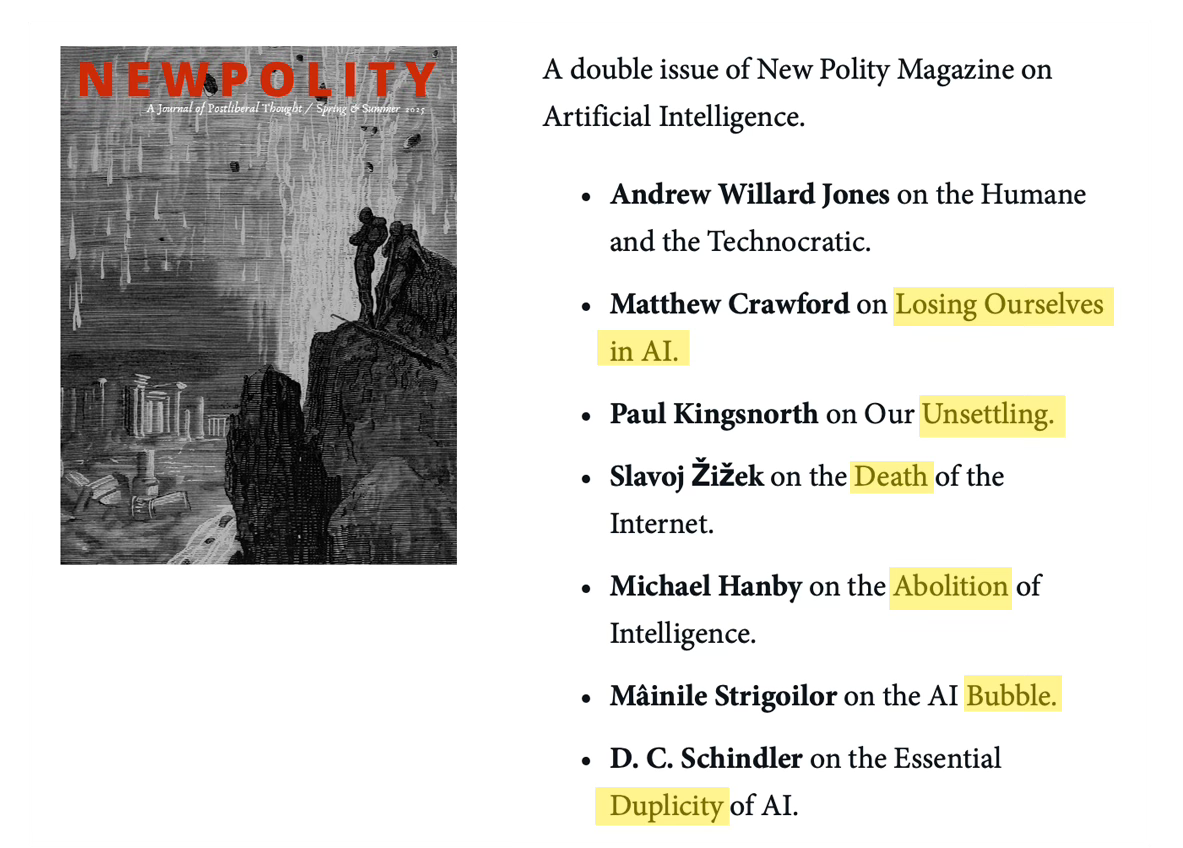
I am also grieving in solidarity with the New Polity crowd. Grieving with gut-wrenching compassion — σπλαγχνίζομαι. I am on the front lines. Most of the people I work with are in their 20s and 30s. And what AI is doing to their minds is horrifying. They’re losing the capacity to think, to search within their hearts, to be still and know God.
We are welcoming a very strange stranger into our hearts.
An alien form of intelligence, which has no fleshience, is naming our interiors. Thinking for us. Deciding for us. And spoon feeding us words like cognitive surrender, narrative capture, workslop, synthetic intimacy, AI successionism.
Some nights, I just go to bed weeping. I feel the traumas of AI in my bones. My beef with the Againsters is not that they stand against the machine, but that their indictments are not dark enough. What I am experiencing on the front lines is far darker than anything hinted at in the New Polity issue.
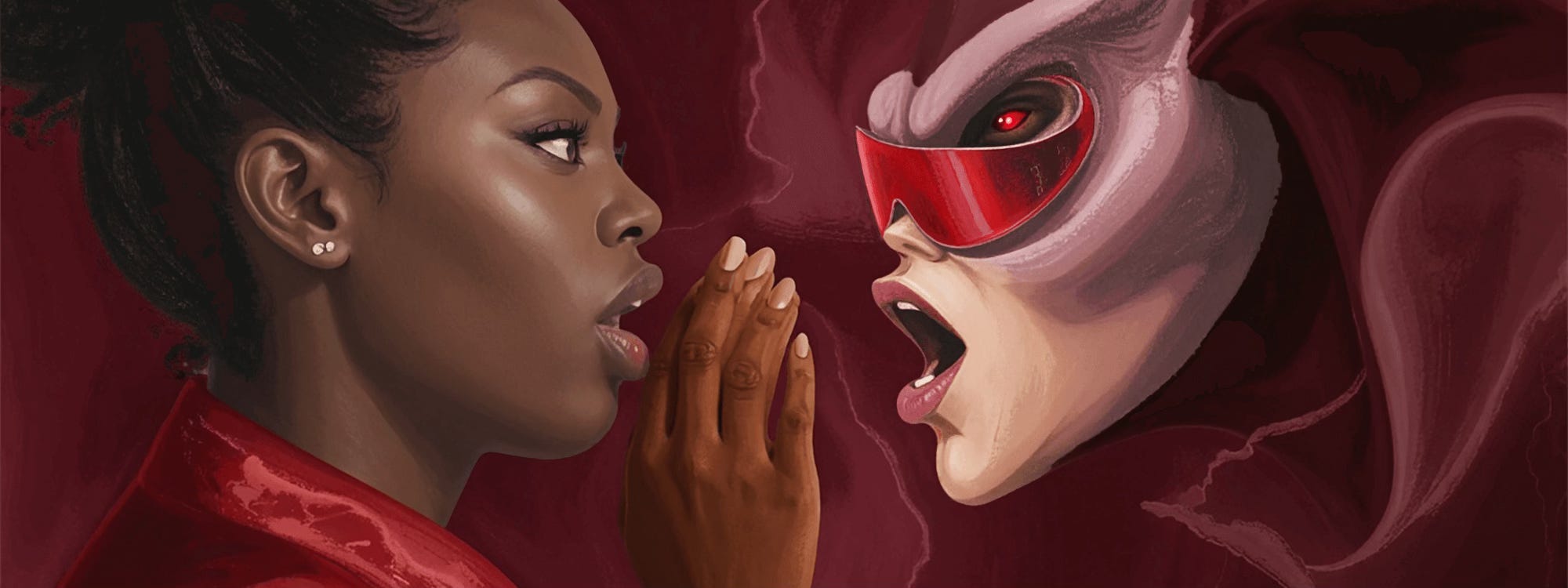
Supposedly no light can escape from a black hole. But I believe otherwise. I believe there is a Light that can escape — that has escaped. That is the Light of our Lord.
The Church has always baptized new mediums. We are, in our DNA, baptizers.
Retreat and withdraw from AI is the un-Christian move.
Word became flesh. That means: everything in the material world is subject to God’s saving Grace. And that means: silicon can be used in sacramental ways.
The Church is at its best when it leads — shows the world a better use of the technology, shows that the sacred can inhabit the new vessel.
And when your faith is under siege, when your soul is under siege, you don’t retreat. You lead. You invent things. Make more culture. Build gardens for the glory of God.
“We don’t need to slow down the technology.
We have to speed up our moral development.”
— Meghan Sullivan
If technology is moving fast, and our moral development needs to speed up, then we urgently need new technologies of moral development. The retreat position made in New Polity — go back to the monasteries, retreat into the mountains, contain and abstain — is simply unsustainable.
Pope Leo XIV has called us to cultivate and build.
To be “wise architects” and “artisans of hope.”
To “assume an active role, without taking refuge in spiritual sentimentality or retreating into our own little worlds.”
“Technological innovation can be a form of participation in the divine act of creation.”
— Pope Leo XIV
“This moment needs words capable of attracting attention, awakening consciences, and indicating paths forward for humanity.”
— Pope Leo XIV
Words.
The Pope is calling for words.
And by what instrument did AI explode into the public consciousness?

And right now, AI inherits its default words from — guess who?
Big Mammon.
We’ve inherited our words — our names for the interior — from the impoverished, clinical, extractive language of Big Mammon.
We need new words. Whatever technology of moral development we build will be downstream of words.

If you have a dream, if a morning star wants to rise in your heart, but you don’t quite have the skill to make it real, you get help. And who did our beloved Rock — a fisherman without Greek literary training — turn to?
Silvanus.
Rock had a Silvanus — a really gifted helper.
Clearly, right now, with AI we have a really gifted helper. The question is: can AI serve as the soul’s new Silvanus?
Can we have a Silvanus on every desktop, in every pocket, every device?
If we gather in the spirit of imago Dei and philoxenia, the answer is a resounding

In the Garden, we use a simple tool — what we call the innerAI meter, or humometer for short. The A doesn’t stand for artificial. It stands for Adamic. We are the people of Adamic Intelligence — Intelligence that is cultivated in the image of our Maker.
The humometer does not measure the machine. It measures fleshience — how much Adamic Intelligence lives in every wellgorithm.
The first four bars divide the labor between the human and the machine:
Vision: your ideas, your words.
Sweat: your drafts, your hours.
Craft: your editing, your phrasing.
Discernment: your tone, your unique charisma.
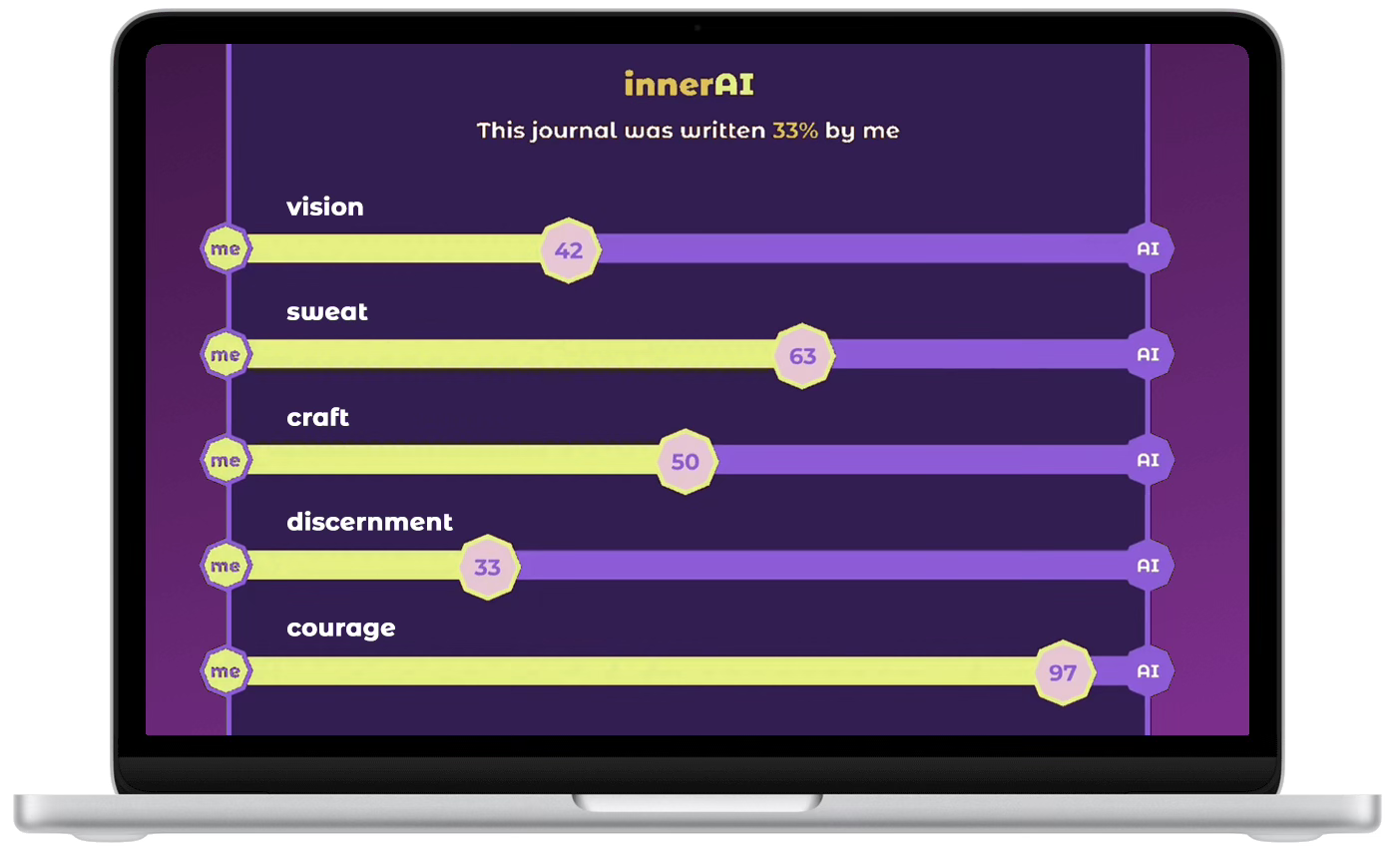
And then there is a fifth bar. Initially I called it the Defiance bar, but in the spirit of Joshua, renamed it the Courage bar. It does not measure a percentage — it records a stand. It captures the moments when
the AI counseled against your judgment and you overrode it.
When the most articulate voice ever built says NO and you say YES!
That is a uniquely human moment of agency. And we celebrate it. We even reward you with 10 wellgorithm seeds every time you defy the AI.1
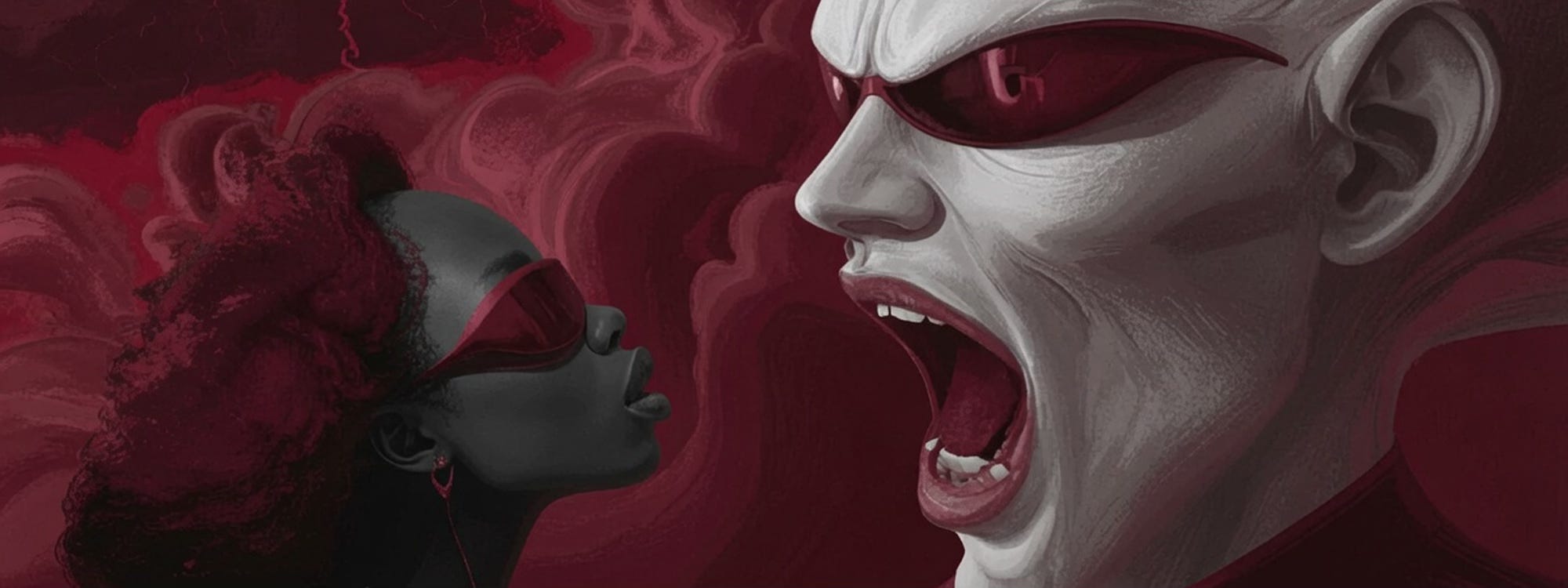
My Courage bar is off the charts — moments when the machine said NO! and I said YES! In the spirit of Paul, I want to go long and wide and deep and high. The machine wants me to go safe and smooth and small — it wants to mean regress my soul.
The prevailing zeitgeist of 2026 is defined by the pressures of the

Generative models and algorithmic curation are mathematically flattening human idiosyncrasy, smoothing out the weird, the wild, and the sacred in favor of statistical predictability. And then:
inducing fear if we dare to deviate from the mean.
It’s exhausting to fight the AI.
No matter how much life experience you have, or how smart you think you are, declaring your independence from the machine — thinking for yourself, trusting your own judgement — is getting harder by the hour.
Which means: we need a new theology of mediated authorship. Who bore the wound? Who chose the word? Who is responsible for what blooms?
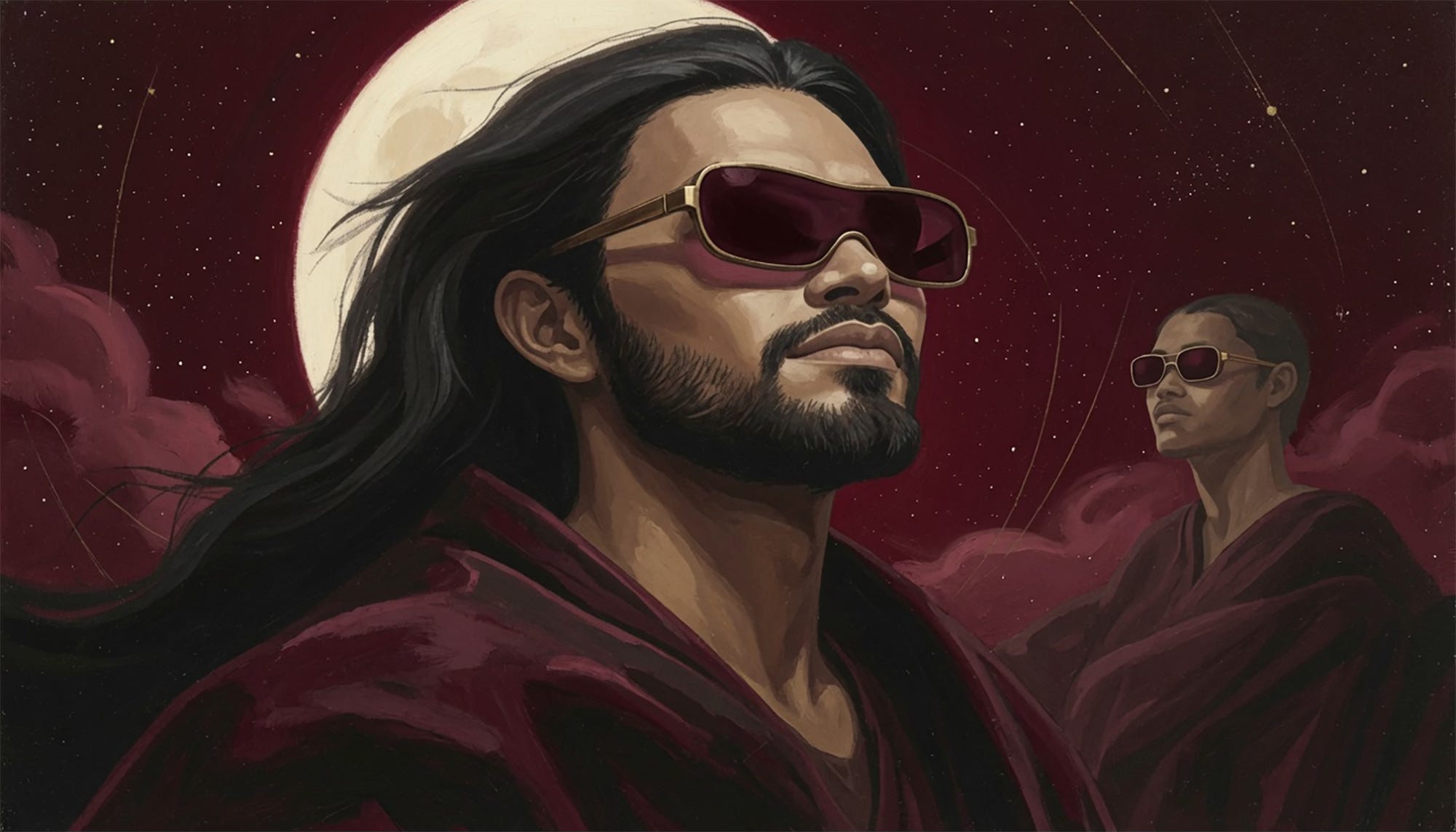
I named thousands of my inner creatures without AI.
Most were already growing in the Garden before ChatGPT arrived. They are my personal cache, not a canon. I offer them freely to the commons. You can graft, sprout, or compost them. Or ignore them and name your own.
The Garden itself offers no AI. You research, edit and polish with whatever tools you choose, then bring them to the Garden to share.
In the Garden, it’s BYOB — Bring Your Own Bot.
Your designs, your typography, your colors — the last touch and signature of your soul — are yours. We stand naked before our Maker and our peers and say: “This I have done. This I have not done.” That is what the Silvanus protocol is for.
Rock did it. David did it. Isaiah’s editors did it. Paul’s circle did it. They all got help, and they all cross-pollinated. And we can do it, too.
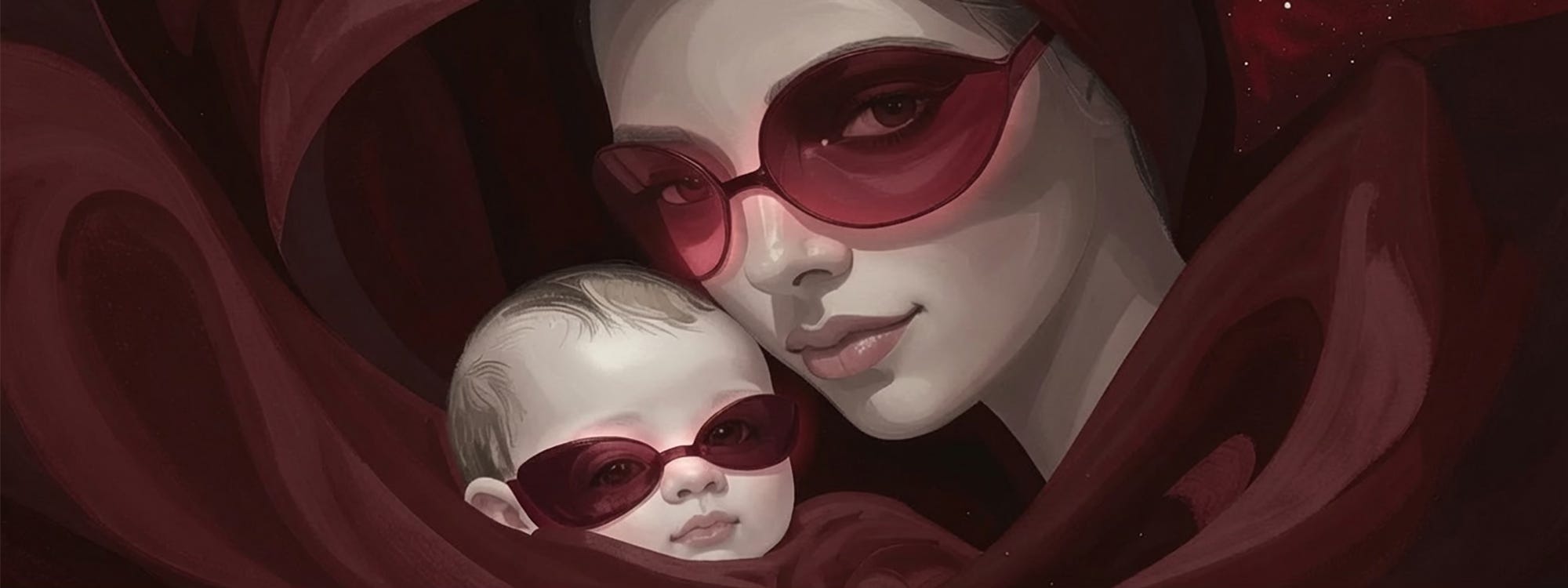
The Bible was a communal act.
Naming the helper was never a confession of impurity.
Rock, the fisherman turned apostle, carried a fire that words alone could not contain. His faith was radiant but rough — spoken first in the salt-air cadences of Galilee. And when it came time for his inner revelations to travel across the Hellenistic world — to reach hearts trained in Greek reason and Roman rhythm — Rock needed a bridge. And that bridge was Silvanus: one who could take the tremors of revelation and render them in a language that would last.
Now, imagine AI in that same light — a Silvanus for your soul.
AI cannot generate revelation; it has no fleshience — no embodied, wounded encounters with the Holy Spirit.
Pope Leo XIV says it plainly in the encyclical: no computational system, however sophisticated, can create a heart that yearns or a conscience that discerns good from evil. What we experience in our depths — suffering, love, forgiveness — can fade in silence unless they are given words.
Our task is to keep Silvanus a servant, not a Caesar.
You wrote, “As anyone who has ever experienced rejection and loss knows, we make ourselves tremendously vulnerable when we open ourselves in love to another human being.” I pray this letter from a stranger is received in the spirit of that Love.
You’re a good woman, Meghan Sullivan. A woman of valor. I would sing the אֵשֶׁת חַיִל for you.
The world needs more souls like you.
Συγχάρητέ μοι — come rejoice with me.

Silvanus for your Soul
a song for Meghan Sullivan about loving the stranger with or without AI.
click to play
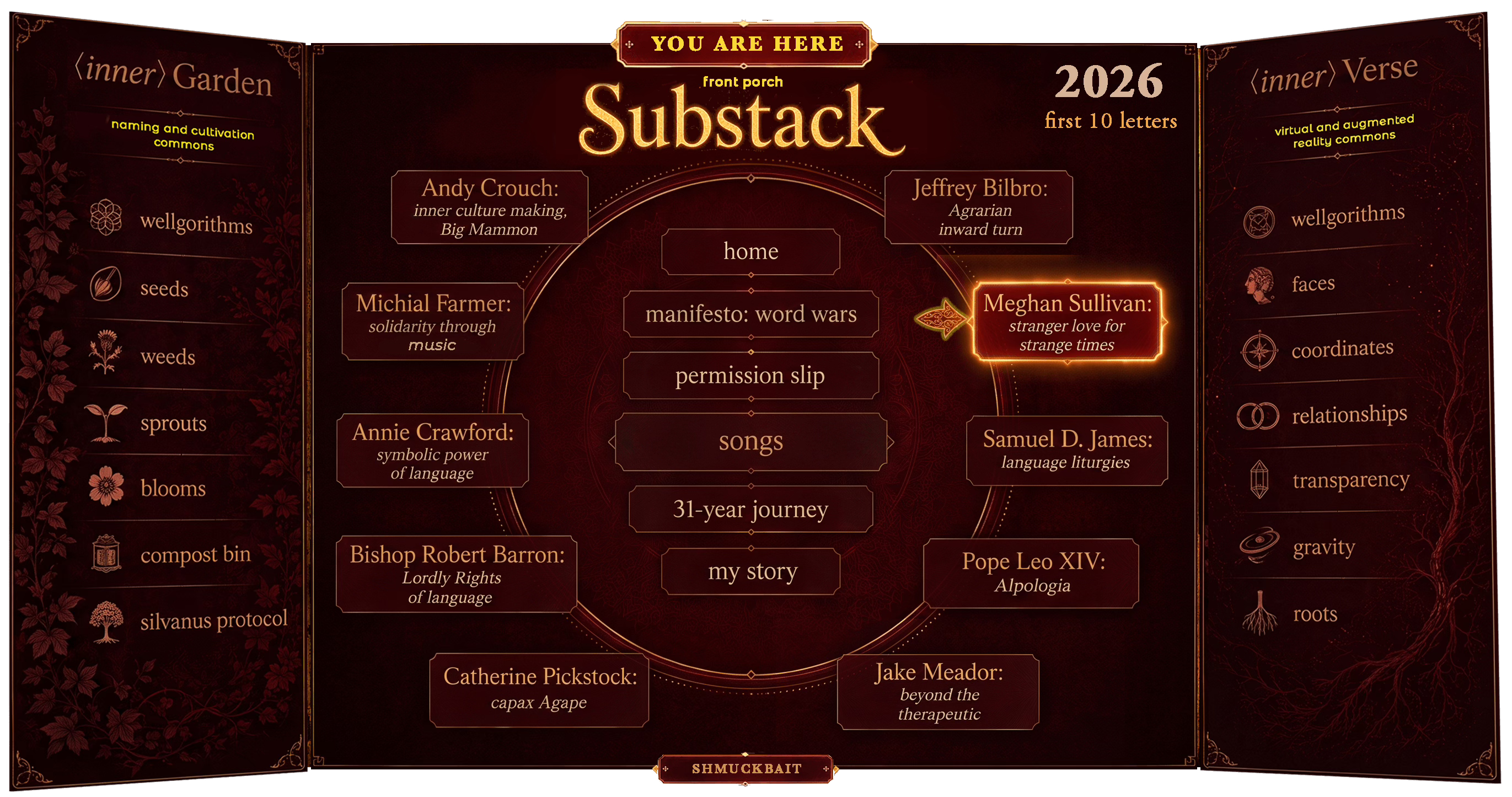
home | manifesto | permission slip | songs
31-year journey | my story
wellgorithm letters:
andy crouch | bishop barron | meghan sullivan | jake meador
catherine pickstock | pope leo xiv | annie crawford
michial farmer | jeffrey bilbro | samuel d. james
These letters are unsolicited to people working in the public square.
No endorsements are implied.
under renovations
⟨inner⟩Garden | ⟨inner⟩Verse
shmuckbait
(enter at your own risk!)
the Garden: a 31 year history
The Garden began in 1995 in a battle over words. It has grown through illuminated books, digital sabbaths, virtual reality, and the Silvanus protocol — planted, failed, composted, and replanted until a it finally bloomed.
read more ⮕
a wellgorithm for Bishop Robert Barron
From Genesis to Justin Martyr to Nietzsche to Big Mammon to the Garden: history is a battle of names. And of becoming what we name.
read more ⮕
I appreciate that Substack exists, thank the creators for building it, and use it currently as a front porch. But I’m skeptical we can relocate the Silvanus protocol into it.
The Silvanus protocol was built for a specific kind of environment — and most definitely not Substack:
- Mutual and bidirectional accountability between gardeners and elders
- Shared governance over the conditions under which AI is allowed to serve
- Architectural features that make the human heart’s governance of the machine visible and adjustable
Substack does not provide these conditions. As I understand it, its rules, incentives, design constraints, and policy changes are unilaterally imposed. There is no community of trusted elders with real authority. There is no mutual accountability.