


Beloved sister Annie, ἀγαπητή —
Grace and peace to you from the One who tabernacles in the tender tent of your heart.
You are a child of the ἀγαπαρχή — the Love-Beginning, the Beloved Bang, the Love that bloomed itself before the world began.
In your seminal paper, Metaphor and Meaning in the Teleological Language of Biology, you write: “Words that imply purpose, design, intention, and desire provide the standard language of biology, and yet both the legitimacy and the meaning of such teleological language is the subject of extended debate among both biologists and philosophers of science.”
You named the open secret: life cannot be spoken without the language of telos, of purpose. And now, as AI overtakes our world, your work on teleology matters far beyond debates in biology.
It matters because AI is becoming the medium through which billions of people ask what a person is, what suffering means, what life is for, and who has the authority over our words.
These are among the most hotly-contested issues of our times.
Let us examine a remarkable case where science and purpose were in harmony. Where new names gave us new powers.
When Benjamin Franklin began studying electricity, people could see the spark and feel the shock. But they had few words for what was happening. So Franklin gave the force a family of names:
Charge.
Conductor.
Battery.
Positive.
Negative.
The names made electricity thinkable, workable, livable.
Before the names, electricity was something that happened to you. After the names, electricity became something you could work with.
Coin the word cell — an invisible kingdom opens.
Coin the word gene — heredity stops being fate and becomes a text.
Coin the word element — alchemy becomes chemistry.
Coin the word valence — matter shows you where it wants to bond.
Name the force, and you can measure it. Measure it, and you can work it. Work it, and you can build the next tool, which asks for the next name.
Word. Tool. Word. Tool. This is the ladder we climbed out of the dark.
And Big Mammon caught wind of it.
It surveyed the landscape for what had not yet been named and priced. Then it asked the only question it knows how to ask: Where is the most valuable real estate left?
Answer: the soul.
Unmapped. Unfenced. Vulnerable. Lucrative. Occupied by billions. Producing signal every waking second.
So Big Mammon claimed the naming rights and turned the soul into billing codes.
We are living through another shock now.
AI is electrifying our schools, our work, our relationships, our art, our attention. But it is also electrifying our interiors — accelerating us, stressing us, numbing us, overwhelming us, misleading us.
And we have very few words for what is happening inside us:
Happy.
Optimistic.
Anxious.
Depressed.
Lonely.
Stressed.
But the electricity analogy only gets us partway, and that brings us back to biology.
You carry within you about 38 trillion bacteria, most of them in your gut, participating in a vast chemical conversation with your body. You also carry 86 billion neurons joined in an almost unimaginably intricate web. And to describe that vast, pulsating, particular interior, Big Mammon tells us to reach for the same few words.
Imagine sending a naturalist into the Amazon and receiving a field report with one category: little things.
That is roughly the resolution at which we perceive our own interiors.
We have named millions of things beyond us — species, stars, minerals, galaxies. Yet for the country closest to us, the one we inhabit with our hearts, we have a handful of worn words. Most were supplied by clinics, labs, platforms and machines.
Biology had its Linnaeus, its great namer, who formalized the naming of the outer creatures. This time, as we name the inner creatures, our Linnaeus will be a people.
Together, we are digging beneath the outdated, abstract language of 19th century academic psychology — which persists to this day in all the frontier models — and rediscovering the sacred dimensions of language.
We are birthing a Democreacy of Words.
Ordinary people — fleshient creatures with bodies, wounds, and breath — are recovering the oldest human work: naming what lives inside.
Over the years, I began calling these names wellgorithms. They originate from the ancient Well that is the Source and fountain of all life.
A wellgorithm begins as a word for what’s moving inside. When you give these inner creatures a face, you can see them, address them, cultivate a relationship with them. You can tend them, graft them, even share them in virtual reality.
Jackie might name one of her inner creatures anxiety∫Ice.
Her anxiety feels cold, paralyzing, lonely.
Reid might call his anxiety∫Fire.
His burns hot — energetic, urgent, dangerously uncomfortable.
Psychologists call this emotional granularity. New words increase contrast. Contrast increases perception. Perception increases agency. Agency increases what you can do.
This is why naming is such a hotly-contested space. Big Mammon, through academic psychology, neuroscience, and corporate reinforcement, claims authority and dominion over our names.
But if naming your inner creatures is poetry as much as psychology, a birthright as much as a science, then we the people — we the gardeners — have every right to name our own creatures.
“Poetry — to name the world God has made — is the first gift and calling given to man.”
— Annie Crawford
Words are power. They change what you can see. They make the defaults, the biases, the hidden assumptions of our culture visible.
Big Mammon’s metaphors have become so ambient, so structural, so invisible, that the people who breathe them every day have forgotten there was ever a different language for the soul.
The words we have been given for what it is like to be human — anxious, depressed, traumatized — are abstract, mechanistic, clinical words mis-applied to the soul.
As AI gets more capable, we all want to know: what are we here for?
What is a human?
How does a human differ from a machine?
Who has the best language to answer that question?
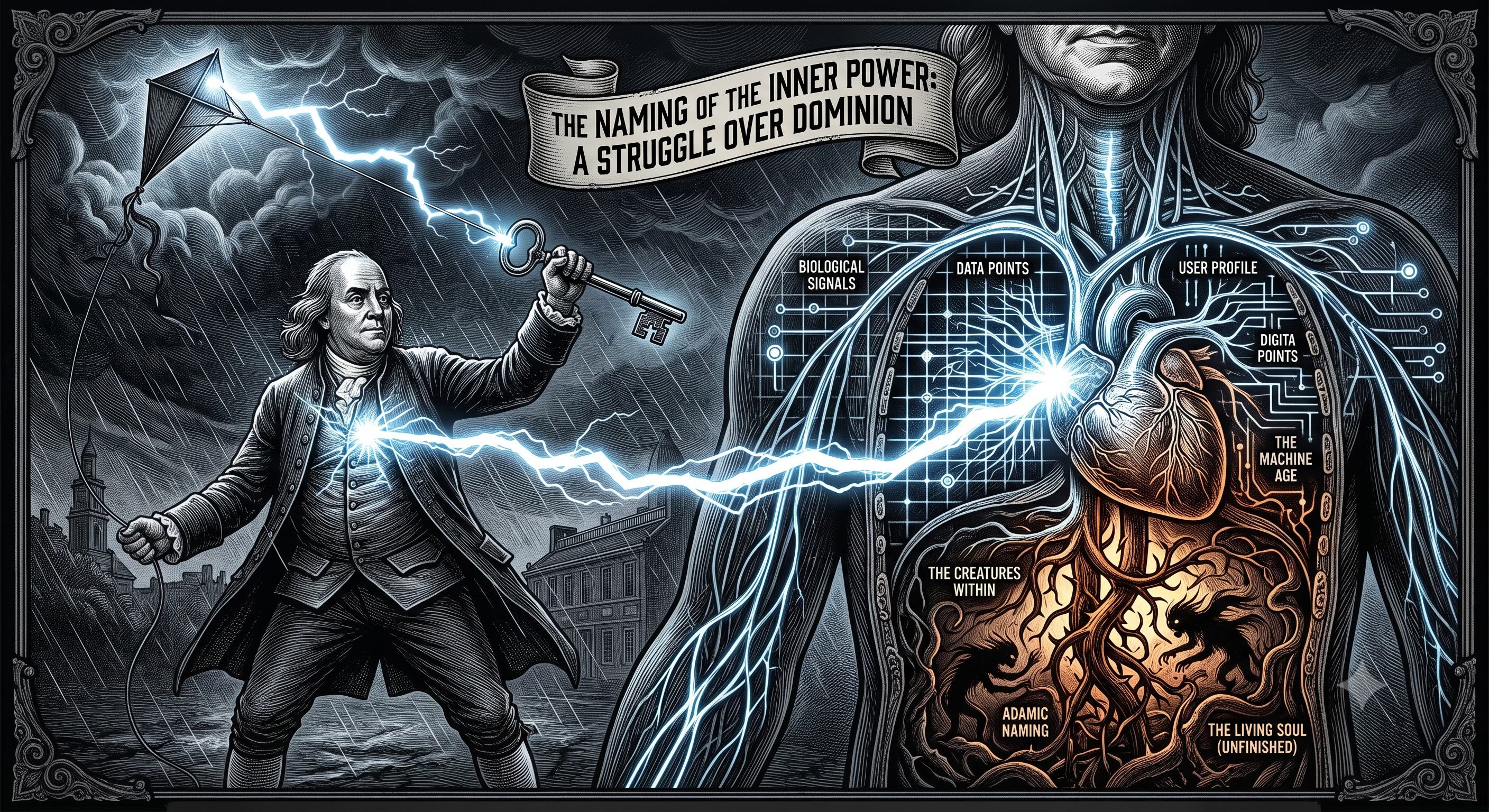
Right now, the most persuasive language says:
You are a user.
You are a data point.
You are an engagement metric.
You are a consumer whose anxieties are monetizable. Whose loneliness is profitable. Whose deepest yearnings are waiting to be productized.
Big Mammon’s language is winning. It is winning in the 167 hours when the Church is closed and the classroom is empty. It installs its names with clinical, white-coat, stock-photo seriousness — without asking your permission. It defines you, categorizes you, sells you to the highest bidder in an invisible market.

There is no neutral language — and this is the sham of Big Mammon.
The difference between a Christian naming commons and a secular commons is that the secular claims neutrality. That is the lie of modernity, and it’s most visible in language.
It makes words such as ethics, freedom, dignity, and agency sound neutral. But their meanings depend upon their teleology — and what we believe a human is, where we came from, and what we are here for.
That’s why, in the Garden, there are two kinds of wellgorithms.
Grace wellgorithms are grounded in Scripture. They say God, Creation, and Spirit out loud. They continue the work of the saints, mystics, and poets who spent two thousand years naming the movements of the soul.
Nature wellgorithms speak in the common language of human experience. They are for anyone with a body and a wound — the agnostic, the seeker, the doomscroller, the friend of another faith or none. They ask nothing of you but honesty.
One Garden, two gates for approaching the same mysterious interior. One through experiences we may recognize across our differences, the other in the particular light of Christian faith.
With each wellgorithm you create, you decide whether it goes in the Grace plots or the Nature plots.
Grace perfects nature — gratia perficit naturam. This is my confession. But I will not place it in another’s mouth.
The more I grow in my faith, the wider I open the door. The Garden is built in the spirit of φιλοξενία — philoxenia, the love of the stranger. Love of the one who is strange to me.
Faith means something when it is freely given. In the Garden, people are never forced. The heart is always free.
Rock says to “love the stranger without grumbling” — ἄνευ γογγυσμοῦ.
Gong-goos-moo is one of my favorite words. In Greek, gong-goos-moo sounds like a crowd mumbling under its breath, trying not to grumble.
So, whenever a stranger gets on my nerves, I just say

68,000 times, until I feel better or drop dead.
“Just as God our Father spoke the whole cosmos into existence through His Word, so we too, made in the Image of God, create new realities through the power of our words.”
— Annie Crawford
“Io vi pungo con le parole” — I pierce you with words.
— Catherine of Siena
We are called, as you say, to “imagine ways to give goodness, truth, and beauty a local habitation and a name.” To turn love and grace and hope into “shapes and forms previously unknown.”
We are in the midst of a Cambrian explosion of these previously unknown shapes and forms. An explosion of words — teleological words. Words of purpose.
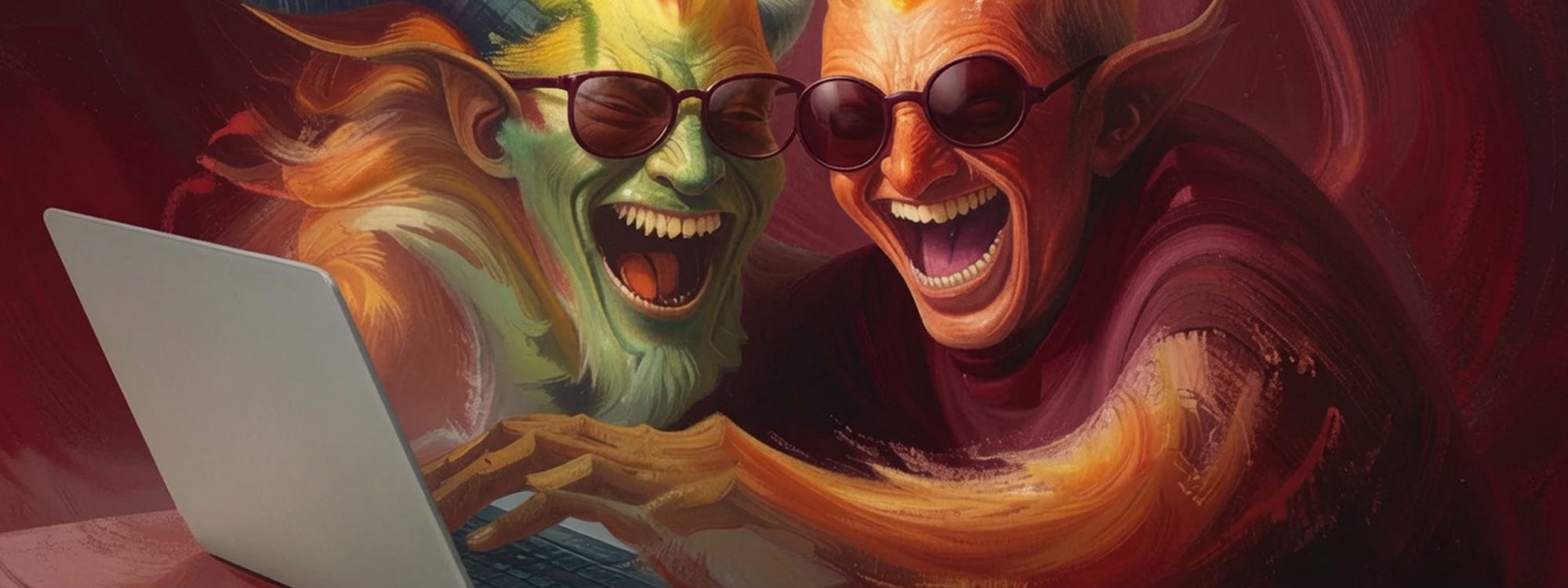
And right in the midst of this explosion, Big Mammon arrives, using AI as its word police. It pressures us in a thousand ways toward the mean. Toward the old language.
Ask AI a question in the old grammar — and most of us do — and it answers in the old grammar. The old ontology.
Grammar governs the question-space. We are not free when an outside power has seized our grammar and limits the possibility space of our questions.
Grammar in. Grammar out.
Grammar out becomes culture in.
Every grammar makes some symbolic worlds intelligible — and makes other symbolic worlds difficult to ask about.
That is why your work on imagination matters. “Imagination is the lens by which we perceive the meaning of the world.”
Grammar grinds the lens.
The old grammar keeps grinding us back into the old world.
If you want to change the symbolic world we are living in, change the grammar. Change the language.
Culture is downstream of grammar.
Beloved sister Annie: You have spent your life holding together what modern grammar pulls apart: science and purpose, intellect and imagination, truth and tenderness, rigor and wonder.
Thank you for helping us explore, in your tender voice, “the realm of life wherein the laws of physics and chemistry mingle with the psychic realities of will and mind.”
As the algorithmic world advances, the symbolic world needs gardeners, poets, and witnesses. Your work is strengthening us at the roots, and we are profoundly grateful.
May the roses of your garden — inside and out — inspire us to create new works of beauty and love, for the infinite glory of God.
Συγχάρητέ μοι — come rejoice with me.
Martin

Annie’s essay: Metaphor and Meaning in the Teleological Language of Biology ⮕
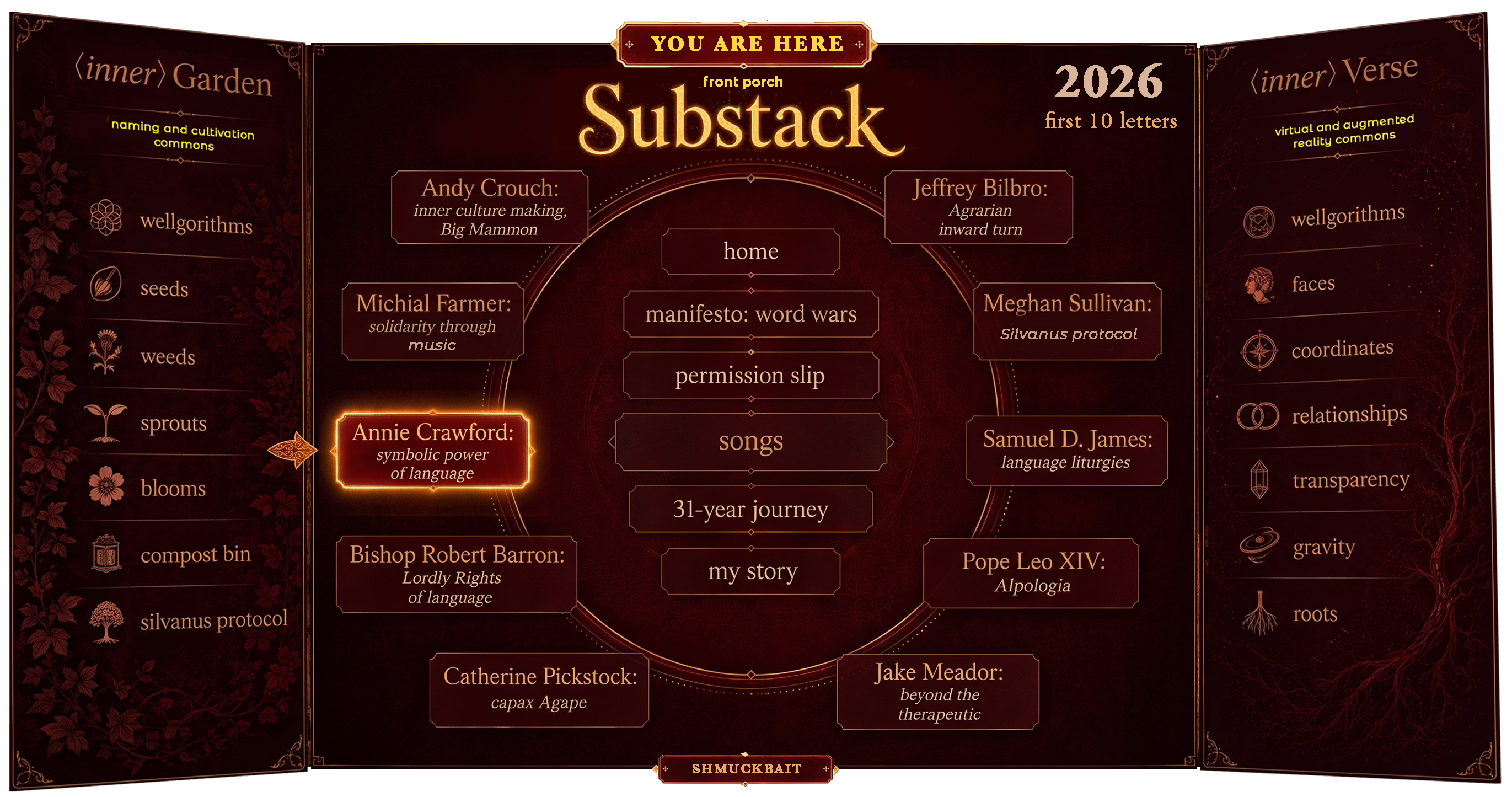
home | manifesto | permission slip | songs
31-year journey | my story
wellgorithm letters:
andy crouch | bishop barron | meghan sullivan | jake meador
catherine pickstock | pope leo xiv | annie crawford
michial farmer | jeffrey bilbro | samuel d. james
These letters are unsolicited to people working in the public square.
No endorsements are implied.
under renovations
⟨inner⟩Garden | ⟨inner⟩Verse
shmuckbait
(enter at your own risk!)
the Garden: a 31 year history
The Garden began in 1995 in a battle over words. It has grown through illuminated books, digital sabbaths, virtual reality, and the Silvanus protocol — planted, failed, composted, and replanted until a it finally bloomed.
read more ⮕
a wellgorithm for Bishop Robert Barron
From Genesis to Justin Martyr to Nietzsche to Big Mammon to the Garden: history is a battle of names. And of becoming what we name.
read more ⮕