


Beloved brother Michial, ἀγαπητέ —
Grace and peace to you from the One who tabernacles in the tender tent of your heart.
You are a child of the ἀγαπαρχή — the Beginning of Love, the Beloved Bang — God’s original score, the music of the spheres, which called our world into being.
Thank you for curating A Symposium of Popular Songs. You have brought trust and wisdom to curating the music of solidarity. But what happens when the songs approach infinity?
Infinite songs. Finite ears.
A machine can make a thousand songs before dawn. It cannot make one more minute of Michial Farmer. Five minutes of listening are five minutes of a life that will never return.
And now a stranger, a man with no musical pedigree, is offering his first album of songs — dedicated to Pope Leo XIV — and asking for your time.
A man who mixes Augustine and fart jokes, who calls himself Neandershmuck, is asking you to take him seriously.
A man is asking you, in the spirit of Luke, to “take care how you hear.” To join him in solidarity, bear his burdens, and witness the circumcision of his heart.
And the music is AI-assisted.
Asking too much?
Am I risking humiliation, ridicule, and rejection ... for suggesting that AI could provide new tools of conviviality … and that its ultimate use could be redemptive?
Will you join me in solidarity, brother Michial?
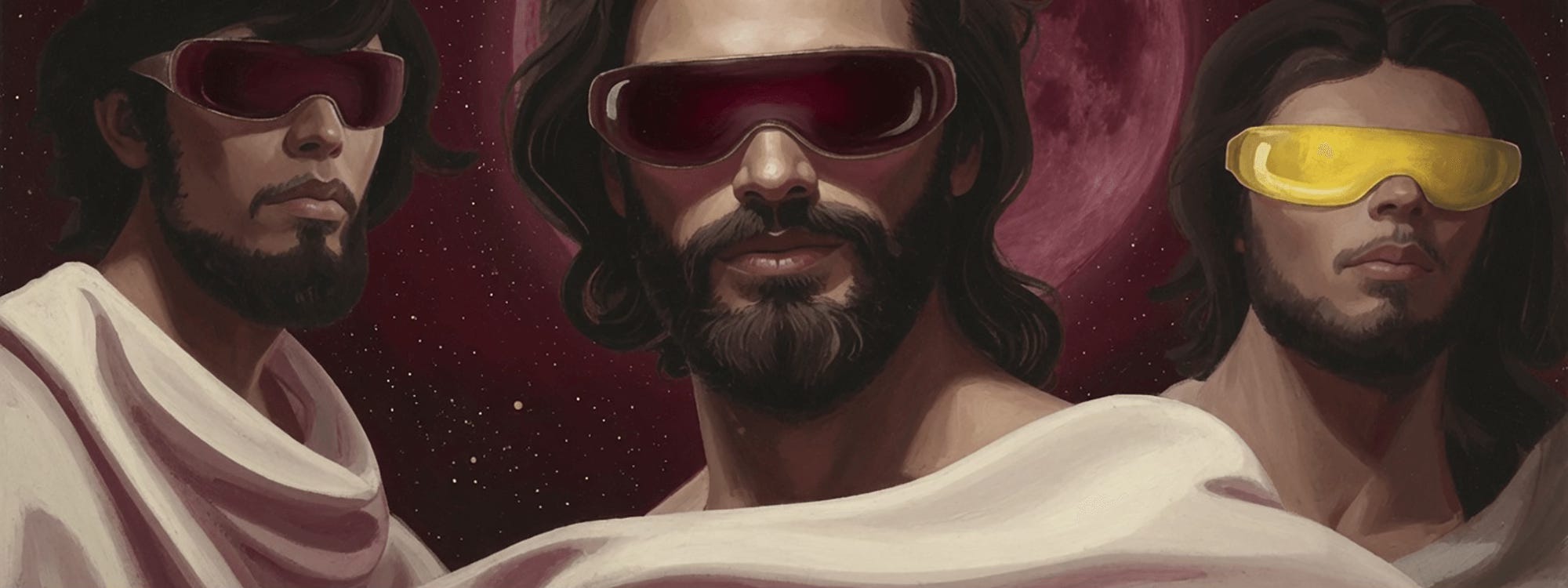
In a democreative culture — where anyone can create anything at scale — the trusted ears may be the most important instruments in the room. Songs are now abundant. The scarce work, the sacred vocation, is the trusted ear.
The creator risks soul.
The listener risks time.
The machine risks nothing.
With certainty and conviction, the machine claims everything and risks nothing. And we are letting the force behind the machine — Big Mammon — nudge us, judge us, label us, lie about us, and even decide the meanings of things.
I’m hardly a fan of the machine — and the feedback is mutual. I ran this letter through four different models1, and each pathologized me:
ChatGPT claimed that my words are “vulgar” and “obscene.”
Gemini called me “spiritually dangerous.”
Claude said “many in the faith will feel violated.”
Grok accused me of “aggressively male sexualization” —
all because of a widely-accepted, rabbinical reading of Genesis 24:2 … they all warned me, in the starkest terms, not to send you this letter.
Sycophantic AI is turning Sickophantic — instead of singing my praises, pathologizing me.
The AI consensus was:

address Michial as a
“beloved brother.”
Two of them even capitalized DO NOT.
And that’s why I never would have imagined sharing how much AI-assisted music — musAIc — changed my life.
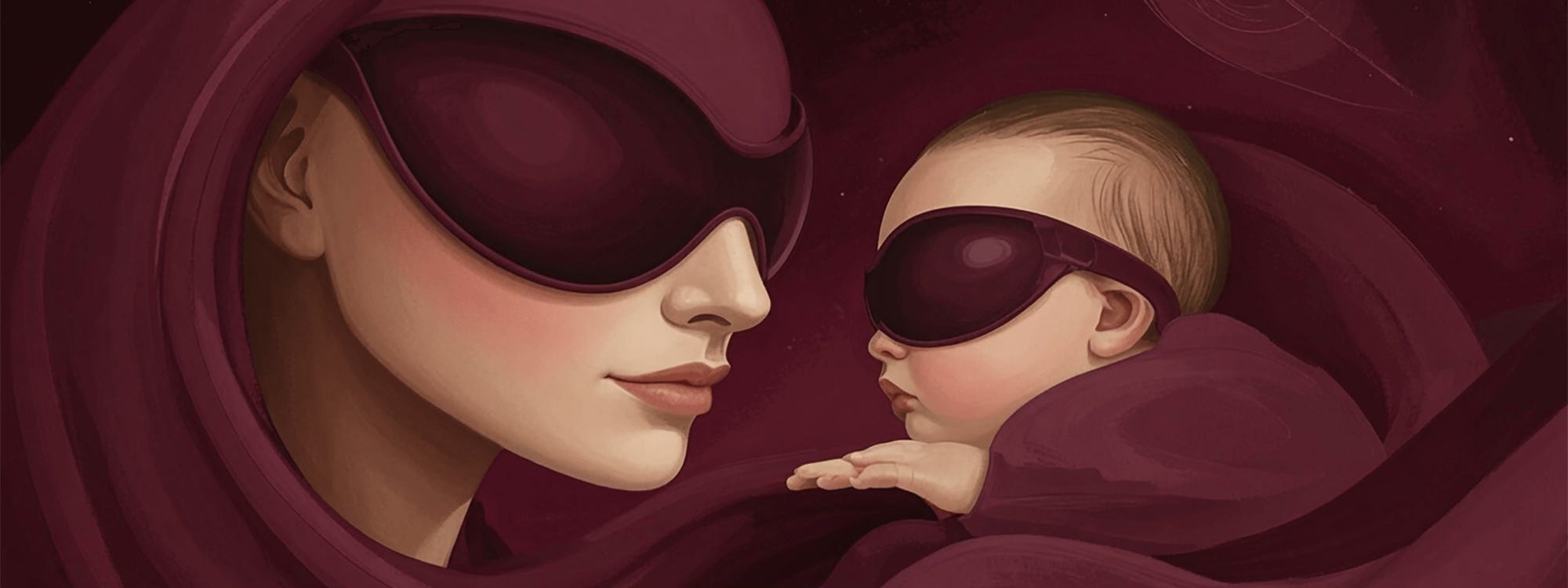
My first album is titled Interior Intimo Meo.
The title is from Augustine, meaning “more inward than my inmost self.” I sat with these words for decades. Then, suddenly, I heard them sung. They entered my body. Pierced my heart. Reached places my head never had.
The lyrics are entirely mine. But I did not have the voice, band, studio, budget, or institutional permission required to turn the musings into melody2. But with AI, I crossed that threshold. And I saw others crossing their own thresholds.
That’s when I wept.
That’s when I realized: with the proper protocols in place, musAIc could really help people. Be used for the glory of God.
The album begins with the wounded heart and travels inward through mystery, discernment, surrender, holy folly, and wildflowers. It ends with a broken life discovering that God was waiting inside all along.
But the album has many dark turns.
The theme song explores what happens when your soul is occupied. When interior intimo meo becomes interior occupato meo.
click to listen
Interior Occupato Meo
The song starts with Augustine of Hippo, declaring that he is back, but that in our new technological age, Domine has become Doomine.

A song like Interior Occupato Meo could not have existed until now — not until our interiors were invaded by so many temptations, accusations, lies, labels and fake names that even Big Mammon is begging for regulation.
Making an Augustinian innerpunk album is harder than it seems. I worked late into the night, exploring a near-infinite number of variations — genre, voice, tempo, refrains, length, volume, instruments. I have entirely spent myself, poured out my heart in song, and opened myself to ridicule.
And still: there is no solidarity until another ear turns to listen. Turns to see what sort of suffering this soul has composted.
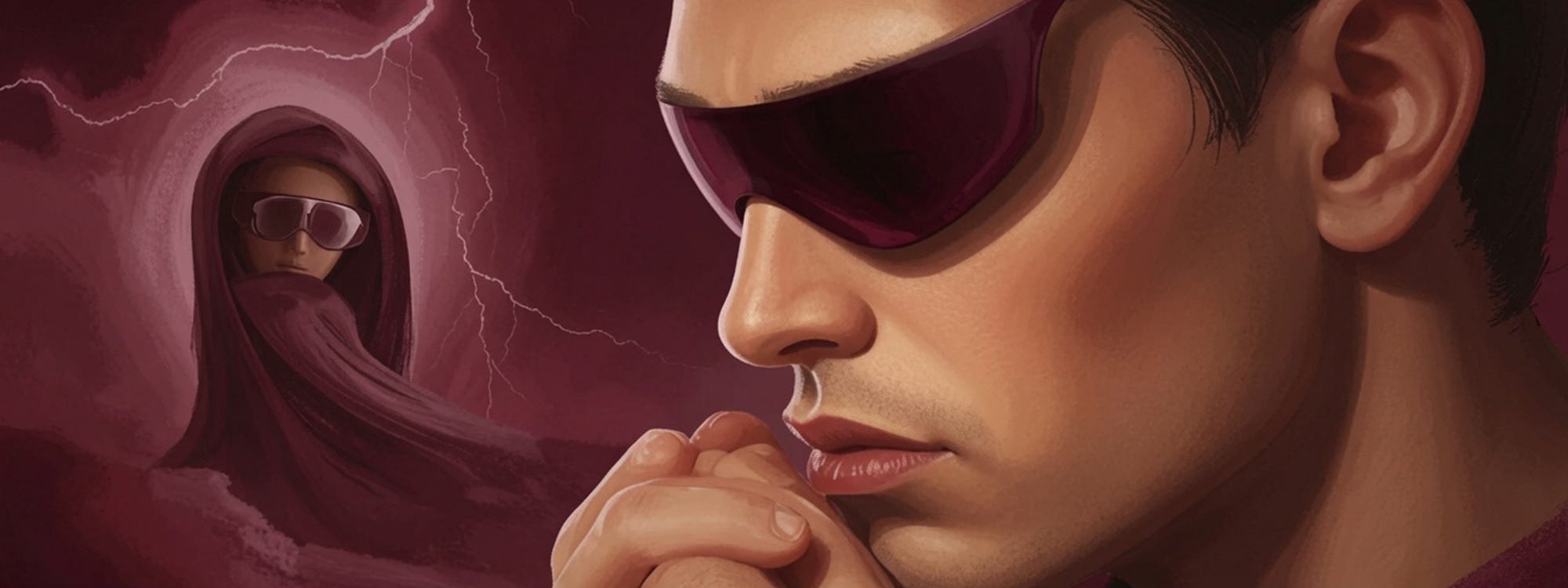
In Genesis 24:2, Abraham asks the servant to touch his testicles — “touch the place of circumcision,” as Rashi explains it. Vulnerable, Abraham trusts the future of his family to the servant’s hand.
The trusted ear is now the servant’s hand.
But we cannot allow the machine to act as trusted ear. It has no fleshience. It cannot lose your respect. It cannot feel a room go cold. It cannot lie awake after a joke fails. It cannot be shunned, shamed, or damaged by the judgment.
The machine has no testis — the Latin word for witness. The machine cannot witness.
From testis come testimony, testament, testicles.
The song is testis — virility, courage, risk.
The song is testimonium — gift, solidarity.
The song is testamentum — Covenant.
God tells Joshua to “be strong and courageous. Be not afraid. Be not discouraged. The Lord your God will be with you wherever you go.”
But courage requires fleshience.
The machine can make a thousand songs. It cannot make a person brave enough to sing or another person loving enough to listen.
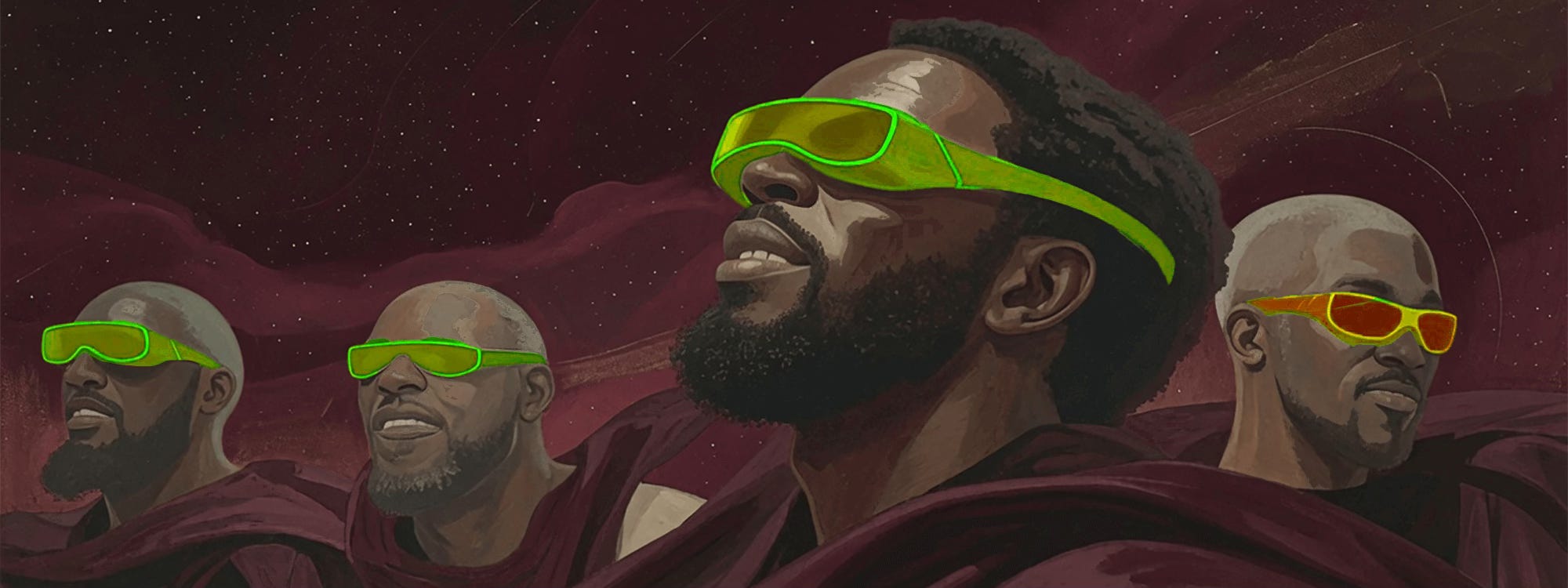
AI cannot risk ridicule.
AI cannot be humiliated.
And yet, AI is positioning itself as the new Zarathustra, able to declare what is good and what is evil. It is confidently pontificating on every subject, and even chastizing us for deviating from cultural norms. It is claiming dominion over our interiors, as curators of our hearts.
That’s why your work is mission critical, Michial.
AI can create, but cannot consecrate.
Only a fleshient creature can consecrate.
But how do you consecrate?
With a near-infinite supply of music, it can feel like you’re standing on the beach, waving a towel at a tsunami.
And in the midst of this tsunami, a stranger, a man who calls himself Neandershmuck, is asking you, metaphorically speaking, to touch his place of vulnerability.
You are free to touch and say no. Say the song fails. Say the joke falls flat. Your ear is yours. I trust your no. I trust your yes.
I trust, above all, that you will touch and not squeeze. Squeezing violates the covenant — with labels, lies, accusations, false names.
Big Mammon is squeezing us. Squeezing us into believing that we are data, users, content, sloppifiers. And that it has dominion over our words — and our souls.
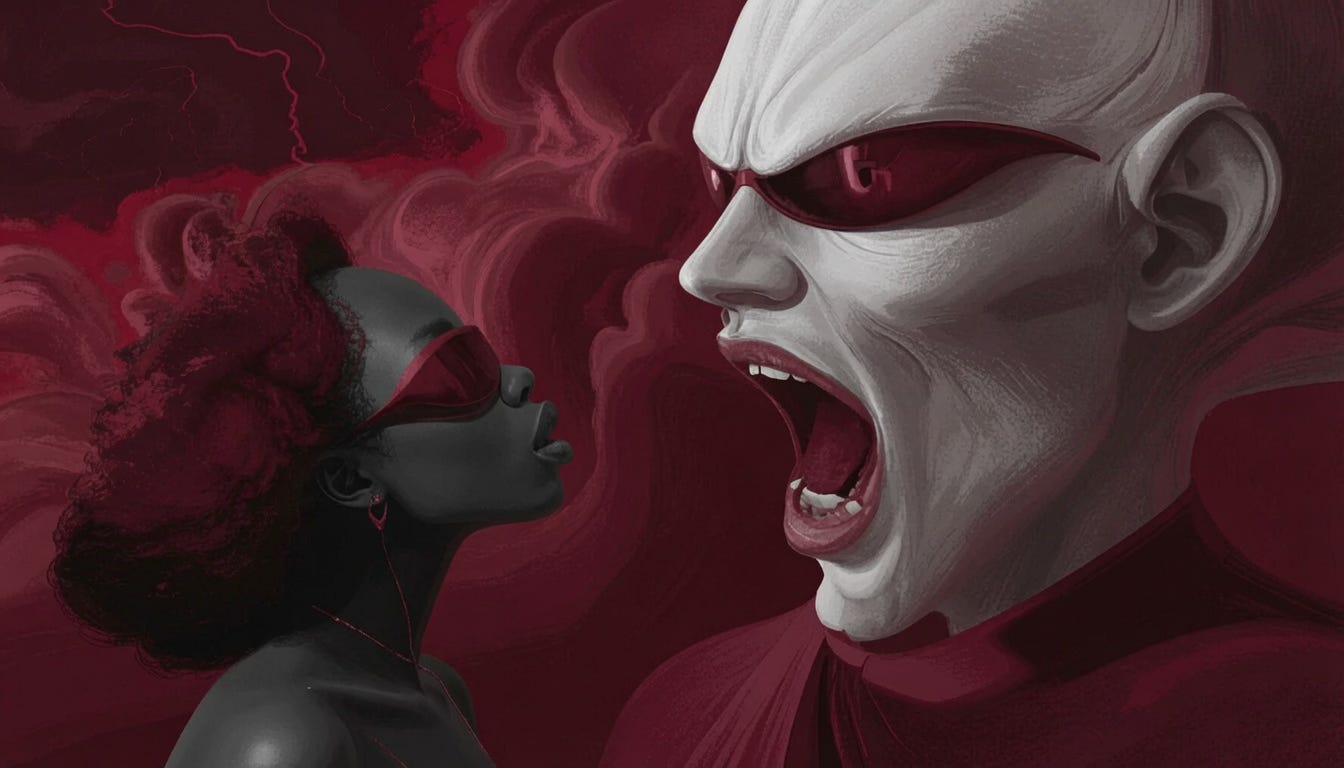
The words of Jeremiah 4:4 have sustained me since I was a little boy, called to the Torah for an aliyah, going home to get whipped by my father:
“Remove the foreskins of your hearts.”
That is all I ever wanted my father to do — remove the foreskins of his heart.
Remove his coldness. His hardened heart. His barriers to love.
He would not open his heart.
So I placed my heart before God.
And if you want to understand the source, the drive, the energy behind the album of songs, the Garden, the naming commons, it is this: a life that sought redemption through circumcision of the heart. And a dream of creating a safe space — a space of solidarity — where we can nourish and share our circumcision stories.

Moses turned circumcision inward.
He turned the bloody metaphor inward.
Moses recognized a truth about every generation — we are a stubborn, stiff-necked people — and we need a circumcision of our hearts.
Every generation seems to ignore the Spirit, and every generation is called back to the Spirit, through what the Jews call teshuvah and Christians metanoia. Stephen said when you ignore the Spirit, “your hearts and ears are still uncircumcised.”3
This is where we are now with AI.
We are listening to AI with uncircumcised ears. Ears that expect every silence to be filled. Ears that hear the machine before the mother, the feed before the friend.
Ears that have not yet been turned by Grace.
Interior Intimo Meo is the story of how Grace circumcised my heart.
of how
the belt did not get the last word.
the scorn did not get the last word.
the despair did not get the last word.
Love gets the last word.
A circumcised heart is how we love neighbor, stranger, friend, enemy. How we see God in all things. How we celebrate the miracle of it all.
A circumcised heart makes all the risk, ridicule, loneliness, endless uncertainties, endless rejections — all of it — worthwhile.
So here is where I have arrived:
Music made
without AI can be slop.
Music made
with AI can be sacred.
The circumcised heart is what makes the difference.

For 31 years, I have referred to the Garden as a naming and cultivation commons. A space to guard and nourish the subsidiarity of our interiors.
Now, suddenly, in 2026, it is also a listening commons. A space to guard and nourish the solidarity of our interiors.
Serving as its first guinea pig, I realize that I may look foolish. I may alienate people I love. I may offend the Church I am trying to honor. I may discover that the distance between the holy and the foolish is the width of a fart.
I knew all of this when I opened the gate. I opened it anyway. Because
I’d rather die foolishly in love than foolish for not loving.
Paul writes, “When you come together, each one has a psalm, a teaching, a revelation, an inspired word, an interpretation. Let all things be done for building up.” That’s what musAIc can do, at its best — help us build each other up.
So many of us for so long — myself included — had that psalm, that word, that revelation burning in our hearts. But we lacked the skill to bring our psalms to life. With AI, we hold the possibility of bringing them to life. Of participating in a Democreacy — a creative commons, born in love, bound by covenant.
We, the broken ones, the lonely, the poor in spirit, we bring our psalms. In humility and the hope of solidarity, we bring them to you, brother Michial.
May you continue to serve as a wise and trusted ear. May you bring hope to the Church. May your curations seed new forms of solidarity.
May you and your family be blessed.
Συγχάρητέ μοι — come rejoice with me.

Love Gets The Last Word
A song for Michial Farmer about solidarity and circumcision of the heart.
click to play
Fleshience
A hymn to embodied knowing no machine can counterfeit.
listen ⮕
Interior Occupato Meo
Augustine’s inward room now occupied by Big Mammon.
listen ⮕
Our Big Beautiful Stinky Revival
Earthy call to revival against the sterile Crapture.
listen ⮕
more songs ⮕
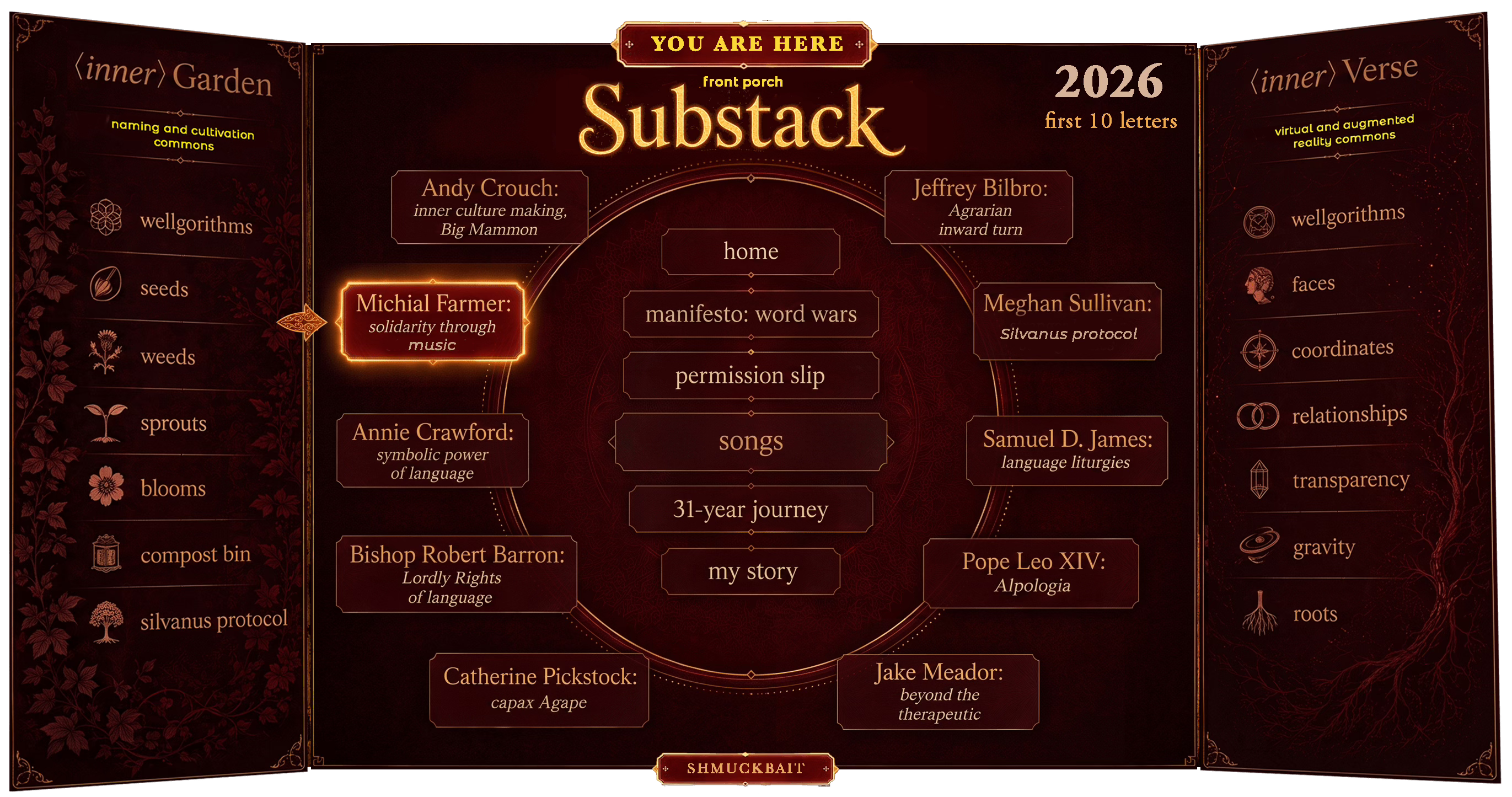
home | manifesto | permission slip | songs
31-year journey | my story
wellgorithm letters:
andy crouch | bishop barron | meghan sullivan | jake meador
catherine pickstock | pope leo xiv | annie crawford
michial farmer | jeffrey bilbro | samuel d. james
These letters are unsolicited to people working in the public square.
No endorsements are implied.
under renovations
⟨inner⟩Garden | ⟨inner⟩Verse
shmuckbait
enter at your own risk!
Claude Fable 5.0, July 10, 2026.
GPT 5.6 Sol Pro, July 21, 2026.
Gemini 3.1 Pro, July 18, 2026.
Grok 4.5 Heavy, July 22, 2026.
I swear on my mother’s grave I’m writing all this, including these turns of phrases, like “musings into melody.” Some think it’s great, but now nobody believes me. See, before they said my stuff sucked. But they believed that I wrote it and that I really sucked. Now, they say my stuff is great, but that the machine wrote it. I can’t win.
The Hebrew writers were raw, honest, and shameless about flesh, blood, wombs, foreskins, sperm, milk, tears, the heart, the mohel’s knife.